
Project Summary / Abstract
In the western US and Alaska, we are seeing significant increases in the frequency and intensity of wildfires, with smoke impacting both urban and rural communities nearly every summer and fall. Concurrently, children growing up in rural communities in this region face unique challenges and may not have straightforward access to educational experiences that cultivate knowledge and interest in biomedical / translational science and public health careers. With SEPA funding and leveraging an existing network of 26 high schools located throughout rural areas of Montana, Idaho, and Alaska, we will add an additional 20 middle schools as we provide biomedical / translation and public health research opportunities for students to explore topics related to wildfire smoke exposures and resultant health effects. With an evaluation plan consisting of a mixed method design, we will test the overall hypothesis that our program can be successfully utilized in rural areas to increase middle school and high school students’ interest in careers in biomedical / translational research and public health. We will test this hypothesis through three Aims: Aim 1) Facilitate remote learning and biomedical / translational research opportunities for students, Aim 2) Facilitate student learning and career preparation through science communication practices, and Aim 3) Provide teachers professional development to support their delivery of health impacts of wildfire smoke exposure curriculum and facilitate biomedical research within the classroom. With SEPA funding, we intend to provide educational opportunities for a projected 1,200 students each year, with many of these students living in rural areas.
-
Aim 1: Facilitate remote learning and biomedical / translational research opportunities for students.
Aim 1a. Develop health impacts of wildfire smoke exposure curriculum for implementation into high schools.
Aim 1b. Revise the high school curriculum for implementation into middle schools.
Aim 1c. Develop a middle school network in rural areas of Montana, Idaho, and Alaska.
Aim 1d. Facilitate student research related to wildfires, biomedical / translational research, and public health.
Aim 1 hypothesis: student-driven research with a focus on the health impacts of wildfire smoke exposure will facilitate their engagement in biomedical / translational research and public health career paths.
-
Aim 2: Facilitate student learning and career preparation through science communication practices.
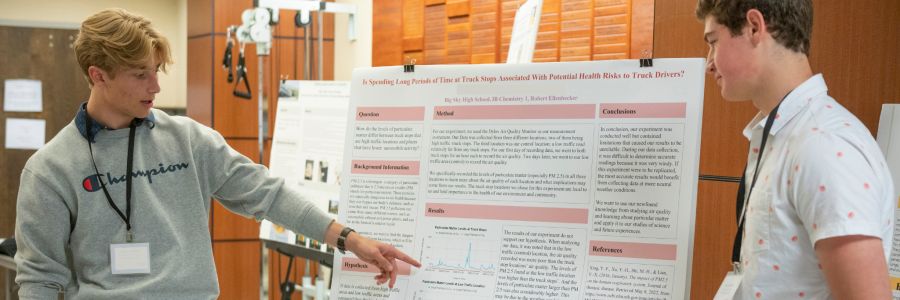
Aim 2a. Based on their research projects, students will develop presentations using writing, data visualizations, and other science communication tools.
Aim 2b. Students will give presentations at one or more public venues including an in-person symposium, online settings, or community settings.
Aim 2 hypothesis: student engagement and learning about biomedical / translational research will be enhanced by producing and delivering science communication to audiences.
-
Aim 3: Provide teachers professional development to support their delivery of health impacts of wildfire smoke exposure curriculum and facilitate biomedical research within the classroom.
Aim 3a. Offer in-person summer workshops to support local teachers in delivering Aim 1 curriculum.
Aim 3b. Offer online summer workshops to support distance teachers in delivering Aim 1 curriculum.
Aim 3c. Offer an online micro-credential in Translating Research Into Action.
Aim 3 hypothesis: teachers who participate in the workshops and / or the micro-credential will gain increased content knowledge and self-efficacy for teaching the Aim 1 curriculum and biomedical / translational research topics to their students.
THE SCHOOL OF PUBLIC AND COMMUNITY HEALTH SCIENCES
The SPARK Program is run through the 91次元's School of Public and Community Health Sciences
Project Title: Students Participating in Air Research & Knowledge Translation
Funding Agency: Science Education Partnership Award (SEPA), National Institutes of Health, National Institute of General Medical Sciences.
Grant Number: 1 R25 GM154354-01
Principal Investigator :
Tony Ward, PhD
School of Public and Community Health Sciences
91次元
Phone: (406) 243-4092
Tony.ward@umontana.edu