CARPENTRY
What You’ll Learn
Students develop job-ready carpentry skills that are used every day in residential construction, including:
-
Rough framing and structural carpentry
-
Roofing, siding, and exterior finishes
-
Window and door installation
-
Blueprint reading and basic layout
-
Concrete forms and site preparation
-
Safe use of hand and power tools
Program Length, Courses & Training
The Carpentry Certificate can typically be completed in two semesters, helping students get to work fast. Training is hands-on and skill-focused, with time split between the classroom and the shop. Students learn by using tools, building projects, and practicing real carpentry tasks that prepare them for job sites. Key courses include:
Semester 1
-
8 credits Introduction to the carpentry trade, including history, career opportunities, and requirements. The course covers building materials, fasteners, adhesives, hand tools, and power tools. OSHA rules and regulations for a safe working place and procedures for compliance are covered. This course includes a four-credit embedded lab (CSTN 122). Students will also learn now to install windows and an exterior door.
-
3 credits Blueprint reading
-
3 credits Introduces the process of distance measurement as well as differential and trigonometric leveling for site layout. It covers the principles, equipment, and methods used to perform the site layout tasks that require making angular measurements. This course is designed to let students apply the blueprint reading skills learned so far to a practical exercise.
-
3 credits Students will receive an introduction to the trades as well as learn the necessary skills to be able to obtain employment and safely participate in trades related careers. Major topics include an introduction to OSHA, including job site safety hazard recognition, hand tool safety, power tool safety, hand signals, and working around heavy equipment. Students also receive an overview of the most common construction materials and their uses, basic framing and carpentry, concrete and concrete forming, blueprint reading, and construction math.
Semester 2
-
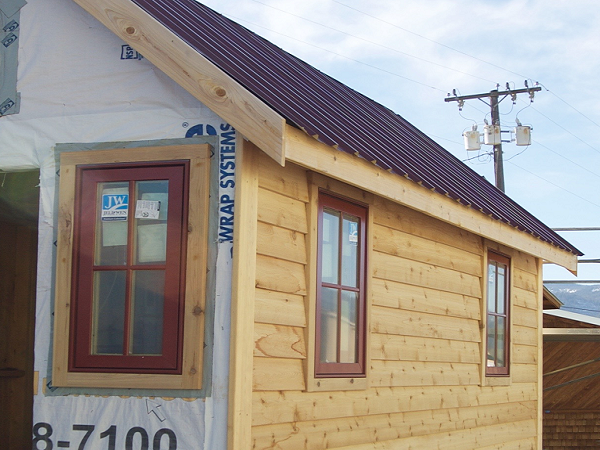
8 credits (4 & 4) Study of various types of siding, gutter systems, roof venting requirements, and framing with metal studs. Installation of sheathing, exterior siding, roofing felt, shingles, insulation vapor barriers, and stairs on small building constructed in CSTN 120 & 122. Installation of wood and metal doors. Demonstration of materials, layout and installation of suspended ceilings.
-
3 credits This course provides an overview of Revit Architectural Software and it’s use to provide 2D, and 3D design, and Building Information Modeling.
-
3-4 credits An introduction to mathematical ideas and their impact on society. Co-Requisite Support sections of M 105 are 4 credits. Higher math courses are also accepted (ie. M115, M121, etc)
-
3-4 credits Expository prose and research paper; emphasis on structure, argument, development of ideas, clarity, style, and diction. Students expected to write without major faults in grammar or usage. Co-Requisite Support sections of WRIT 101 are 4 credits.
-
1 credit This course will introduce students to interpersonal communication theory which can be applied to a workplace environment. Students will learn effective communication strategies that promote success in professional and personal relationships.
Career Opportunities & Labor Market Data
$ 58,110
Carpentry offers solid earning potential for workers with job-ready skills and experience. ¹
4% Growth
Average projected job growth over the next 10 years indicates continued demand for skilled carpenters and steady employment opportunities now and in the future. ¹
$23.29 - $30.75
The average hourly wage reflects steady, dependable pay for carpenters working in residential and commercial construction. ¹
Career Pathways That Stack and Scale
The Carpentry Certificate prepares students to build structures from the ground up, with hands-on training in framing and residential construction skills. Graduates are ready to work as crew members on both residential and commercial construction sites, gaining valuable job-site experience. From there, students can stack this certificate into the Construction Management AAS degree, where the focus shifts to managing residential construction projects and leading job sites.
This certificate stacks directly into the Construction Management AAS degree, giving students a clear path to advance their careers. Students can enter the workforce quickly, build experience in the field, and return to complete the AAS to move into lead carpenter, foreman, or residential construction management roles.
Advising & Support
Have questions about the Carpentry Program or getting started at Missoula College? Our advisor is here to help with program details, admissions, and next steps to enrollment. Reach out anytime—we’re happy to help you figure out the best path forward.
Lucy Ruediger - Program Coordinator
Email: lucy.ruediger@umontana.edu
Phone: (406) 243-7640
You might also be interested in: