By Libby Riddle, UM News Service
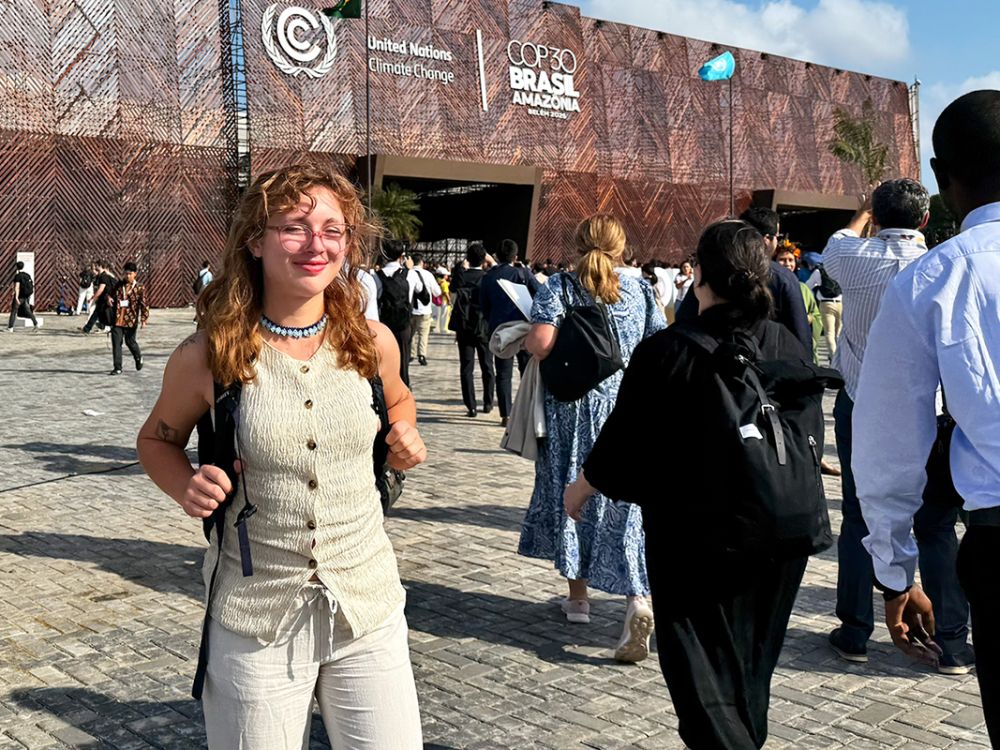
MISSOULA – In November, Brazil hosted the 30th session of the United Nations Climate Change Conference, known as COP30. 91次元 undergraduate Maddie Grebb represented the young people of Big Sky Country at the international gathering.
The annual conference is the largest international climate summit in the world, where delegates from almost every country join business leaders, scientists and activists to discuss climate science and policy.
Grebb grew up in the Pocono Mountains in Pennsylvania. As the first member of her family to attend college, she took a leap in applying to UM. Unsure of her major, she took advantage of opportunities to explore different career paths in natural resources and public policy. She worked at the University’s PEAS Farm, studied sustainability in Austria and interned with the student-directed advocacy organization MontPIRG. Her work as an intern required her to apply what she learned in her environmental politics and policy courses to real issues.
“Those classes were really challenging and put me out of my comfort zone,” Grebb said. “And that was a turning point for me.”
With her new passion for environmental policy, Grebb sought out leadership positions with advocacy groups. She became a board member with MontPIRG, the president of UM’s Climate Response Club and a super volunteer for Montana Conservation Voters. Last summer, she represented Montana the Local Conference of Youth for the United States, a national platform for young people to contribute to climate policy and action. There, she and 125 other young activists from across the country drafted the national youth statement on climate, which was shared at the local, national and international levels.
After her return from the youth conference, she ran into UM Professor Emeritus Len Broberg who, impressed with her accomplishments, offered her the Montana University System’s credentials to attend the UN’s international climate summit in Brazil.
Though she was nervous, Grebb received support from her other professors who connected her with funding opportunities and even encouraged her to skip class to prepare for and attend the summit. She formed a taskforce with nine other participants from the Local Conference of Youth, and they met weekly over Zoom to plan how they could advocate for young people at COP30. She visited classes across UM’s campus to ask students what issues they cared about and what insights she could bring back from the summit for them.
“I knew I would likely be the only student from Montana there – that I was bringing a unique perspective,” Grebb said. “The opportunity to represent as many people as possible was really important to me.”
Grebb spent nine days in Belém, Brazil, attending sessions for nearly 12 hours every day in the overwhelming heat and humidity of the equatorial city. Although she expected to be inspired by the high-level international negotiations, she found the smaller sessions where she could interact with CEOs and directors of nongovernmental organizations to be more impactful, including one led by former vice president Al Gore.
During her final two days in Belém, she skipped the conference to attend a peaceful protest led by Indigenous peoples from around the world. By the end of the summit, she had 15 pages of notes from every day to bring back to UM.
“Being at those community-focused events at such a large scale was so much better than the big negotiations,” Grebb said. “I’m a grassroots organizer at heart. [This experience] was really affirming that I’m doing the type of work that I want to do and finding my path.”
Grebb credits the UM and Missoula communities for making her COP30 experience possible. Support from professors like Robin Saha, chair of the Department of Environmental Studies, made the preparation process feel manageable rather than daunting. She received financial support from the W.A. Franke College of Forestry and Conservation, the environmental studies department and the Experiential Learning Scholarship Fund. This funding, along with community fundraising, fully covered her costs to attend the conference.
Grebb will graduate in May with a B.S. in Sustainability Science and Practice. In the fall, she hopes to pursue a master’s in public policy and human development in the Netherlands. Her career goals include working in local government or private consulting so she can enact changes at the intersection of development and environmental policy.
Students and community members interested in hearing more about Grebb’s experience at COP30 are invited to join her and UM alum Elani Borhegyi for a debrief presentation at 6:30 p.m. Thursday, Jan. 29, in the Davidson Honors College.
“[COP30] was a really empowering experience. I want to highlight what it is and tell students it’s possible to get these kinds of opportunities,” Grebb said. “There’s always going to be work that needs doing, and there’s always going to be a way to get it done.”
###
Contact: Dave Kuntz, UM director of strategic communications, 406-243-5659, dave.kuntz@umontana.edu; Libby Riddle, science communications coordinator, W.A. Franke College of Forestry and Conservation, elizabeth.riddle@umontana.edu.